
Characterizing Hysteris - Gain, Harmonics, and non-linear control.
Adam Greer
A primary goal of the Hysteris design process was to build a pedal with unconventional distortion characteristics. To determine if I achieved that goal, I characterized the pedal’s gain, harmonic distortion, input-level response, intermodulation distortion, and frequency response.
My initial hypothesis was that Gain would primarily control the distortion amount while Stability would control its character. The measurements showed a more complex relationship; the knobs interact to affect the distortion magnitude and harmonic character, often in strongly non-linear ways.
All measurements were taken using an Analog Discovery 2 controlled through custom Python scripts. A baseline correction based on the measurement setup’s noise and distortion floor was applied to reduce the contribution of the test equipment and provide a clear picture of the pedal itself.
Gain is not a simple distortion control
The following graph maps total harmonic distortion (THD) across 25 combinations of Gain and Stability settings:
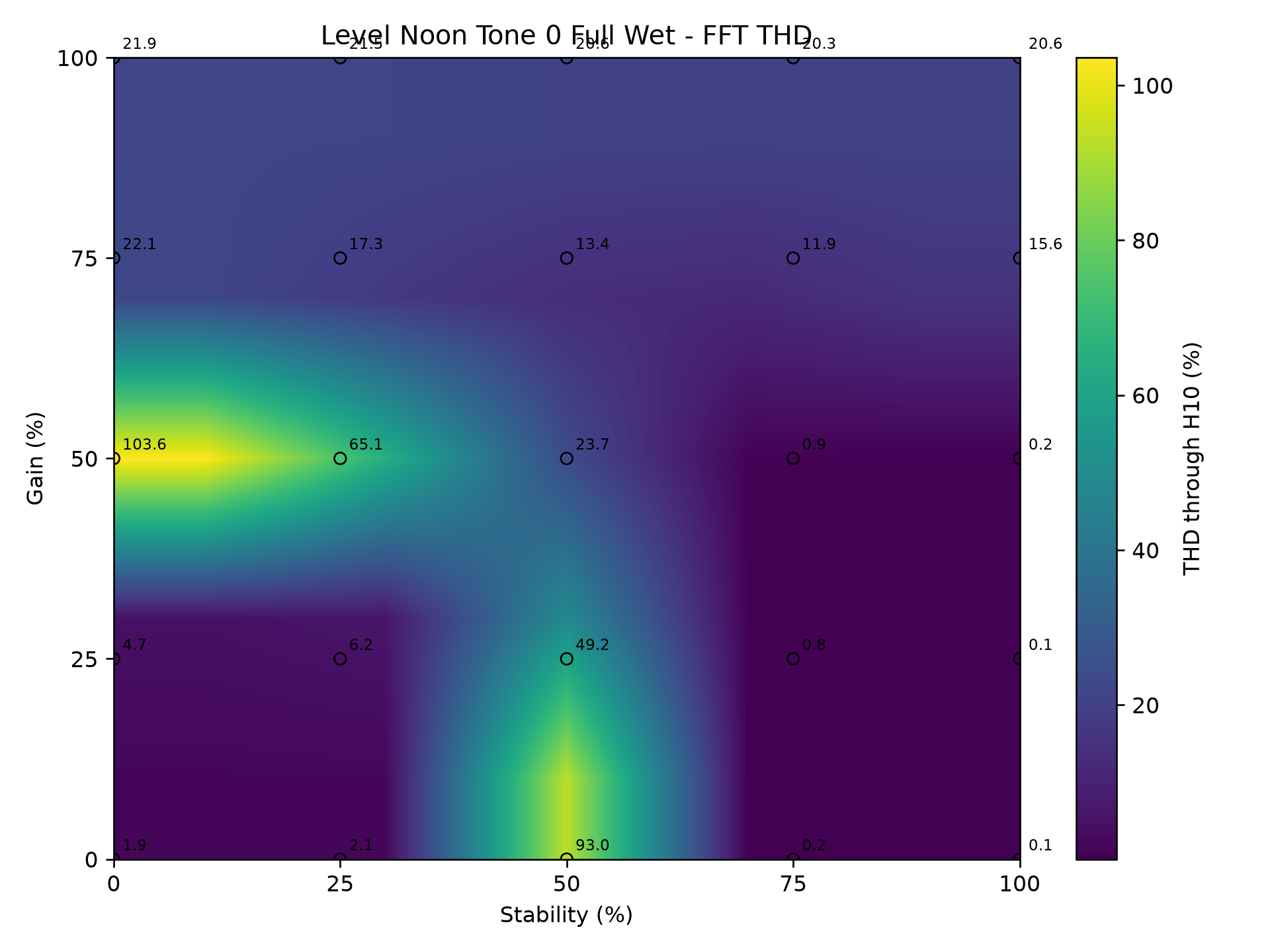
Figure 1: THD measured across Gain and Stability settings
The first result was unexpected: changing either control does not produce a simple monotonic increase in THD. As seen in the graph, the distortion level rises and falls across different combinations of Gain and Stability.
My first thought was that this behavior may be caused by a drop in the fundamental frequency’s (H1) gain. If H1 was collapsing at certain settings, the calculated THD percentage could dramatically rise without a related increase in harmonic content.
To test that possibility, I repeated the sweep while only measuring the H1 content:
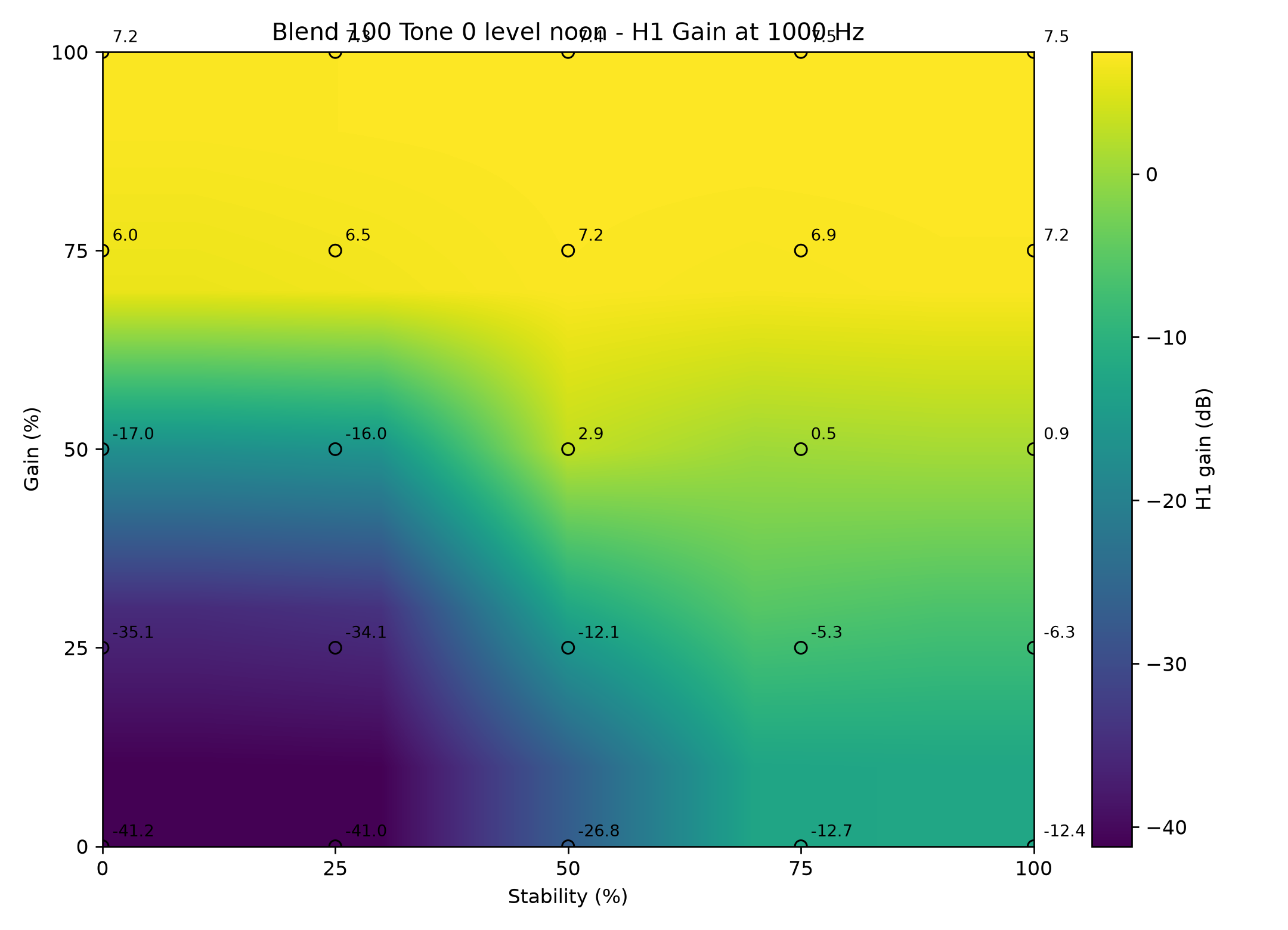
Figure 2: H1 Gain heatmap across Gain and Stability settings
The H1 measurement did not explain the pattern observed in the THD map, indicating the effect is not simply the result of a collapsing fundamental.
Distortion Character vs Knob Position
The next step was determining how different Gain and Stability combinations affected the character of the distortion instead of only the magnitude.
The next measurement mapped the dominant harmonic across the same 25 knob positions:
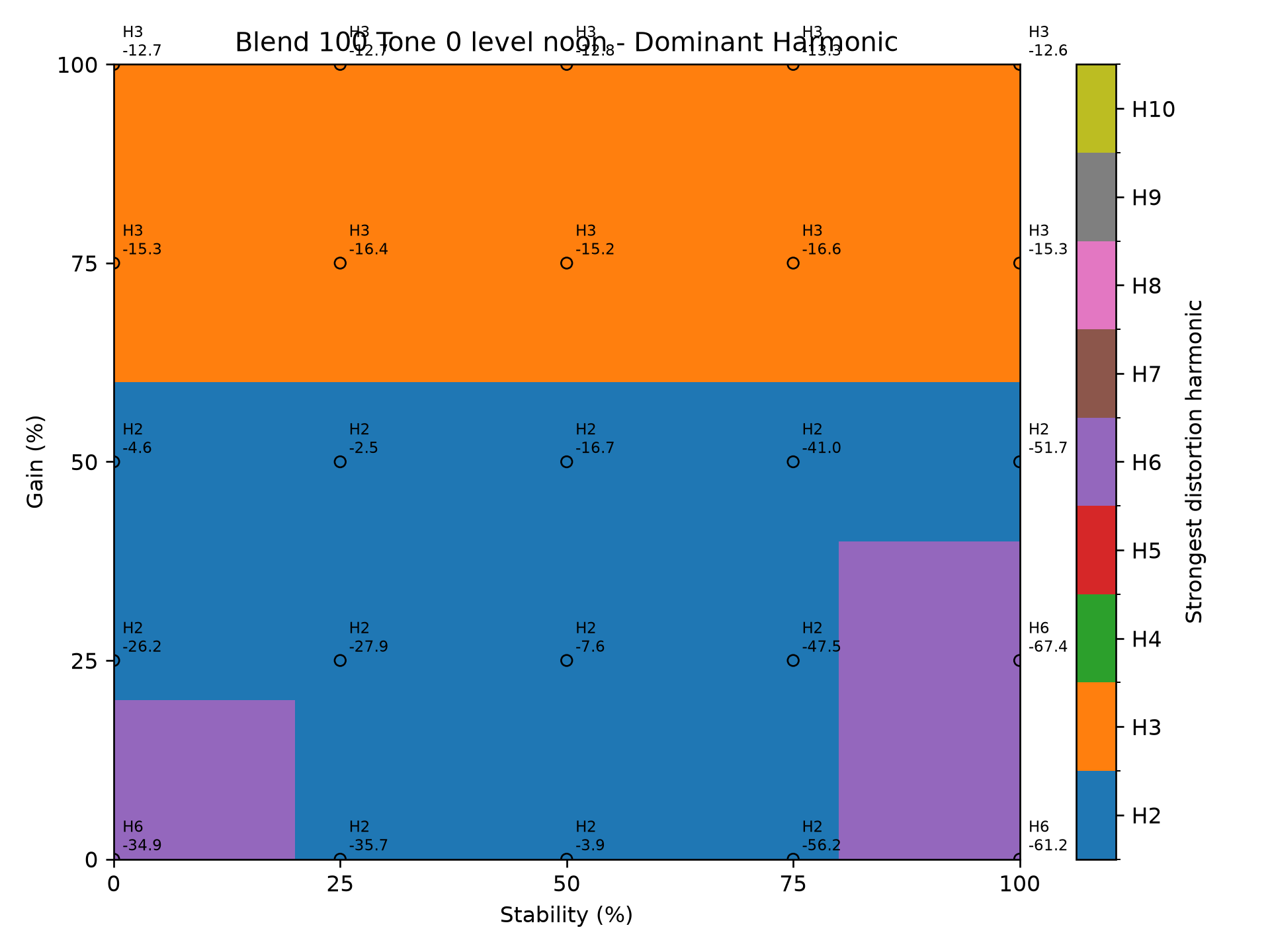
Figure 3: Dominant harmonic map across Gain and Stability settings
The most striking result was the Gain knob’s influence.
At low Gain settings, H2 dominates the signal for the middle stability range. There are some small pockets of H6 dominance near the extremes of the Stability control as well. Once the Gain moves above 50%, the dominant harmonic shifts towards H3.
This is a reversal of my initial hypothesis. I expected Gain to primarily control distortion magnitude, but the measurements show that it also has a major influence on the distortion character.
I then measured the balance between odd- and even-order harmonics. In the following graph, positive values indicate an odd-harmonic bias and negative values indicate an even-harmonic bias:
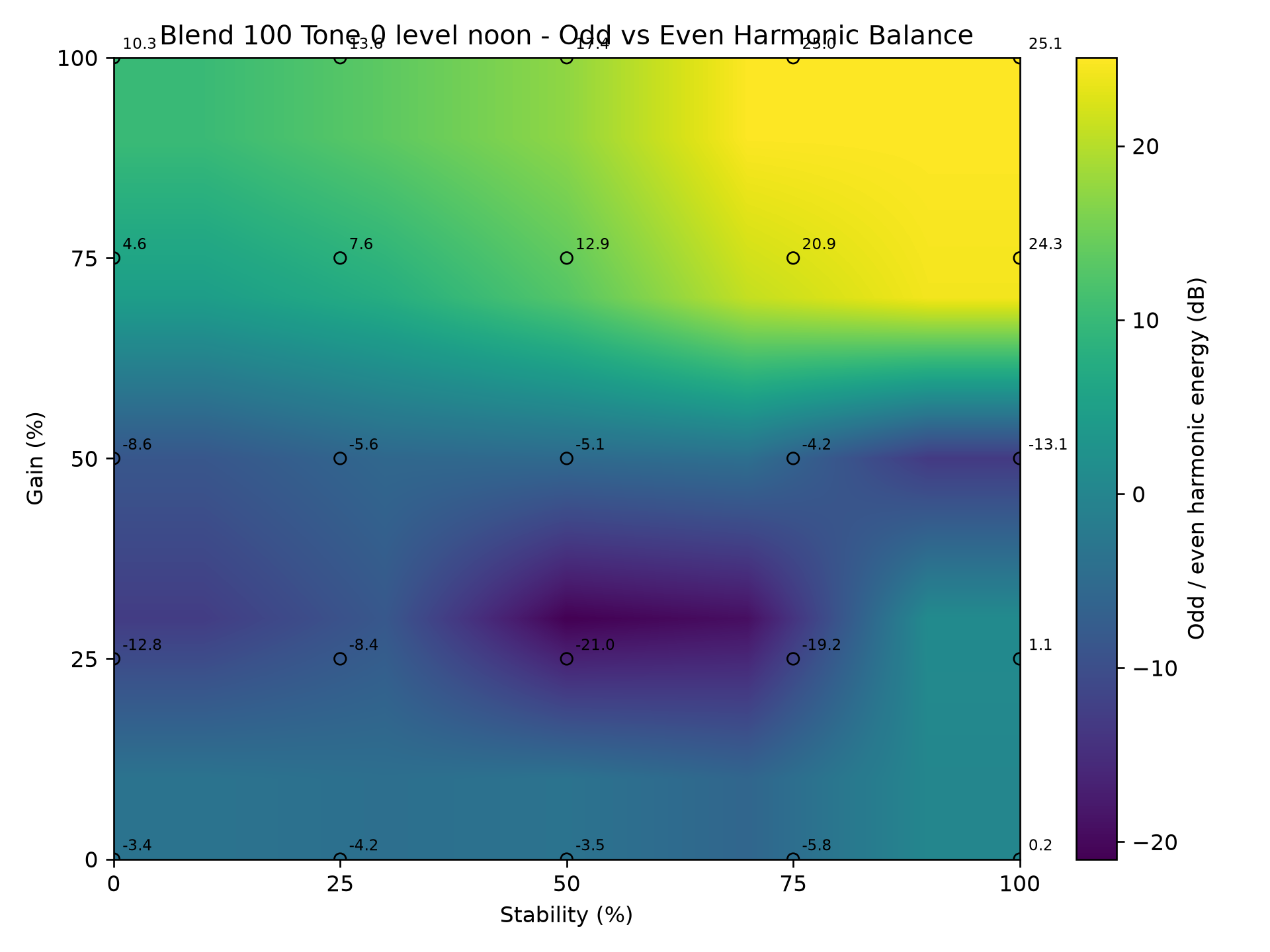
Figure 4: Odd/Even harmonic balance across Gain and Stability settings
This graph continues the trend of the Gain impacting the harmonic character. At low settings, it remains even biased and at high settings it shifts towards an odd bias.
The Stability control has the most effect in the middle-Gain range. At lower Stability, the distortion is more evenly distributed between even and odd harmonics. Increasing Stability shifts the balance towards a much more odd biased signal.
These shifts from even- to odd-dominant regimes represent a tonal shift in the character of the distortion. A deeper explanation of the even- and odd- harmonic balance in distortion pedals is located here:
Rather than one knob controlling “amount” and one controlling “character,” the two controls interact to determine both.
Input Level vs. Distortion
I also wanted to investigate the playing dynamics of the pedal, specifically how the input level affects distortion.
I measured the THD at various knob positions and input levels. For these measurements Level, Tone, and Blend knobs were held constant while Gain, Stability, and input amplitude were varied:
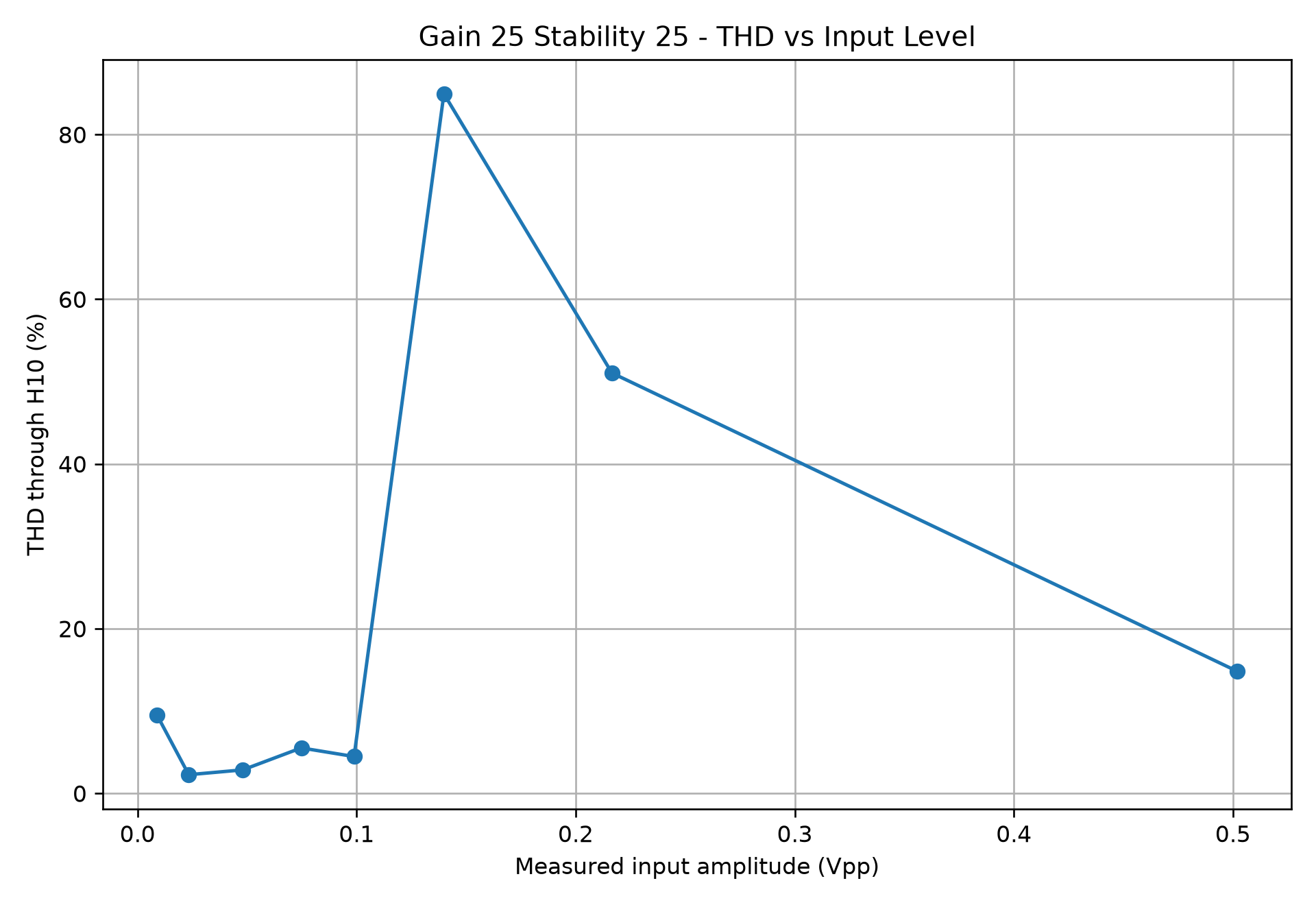
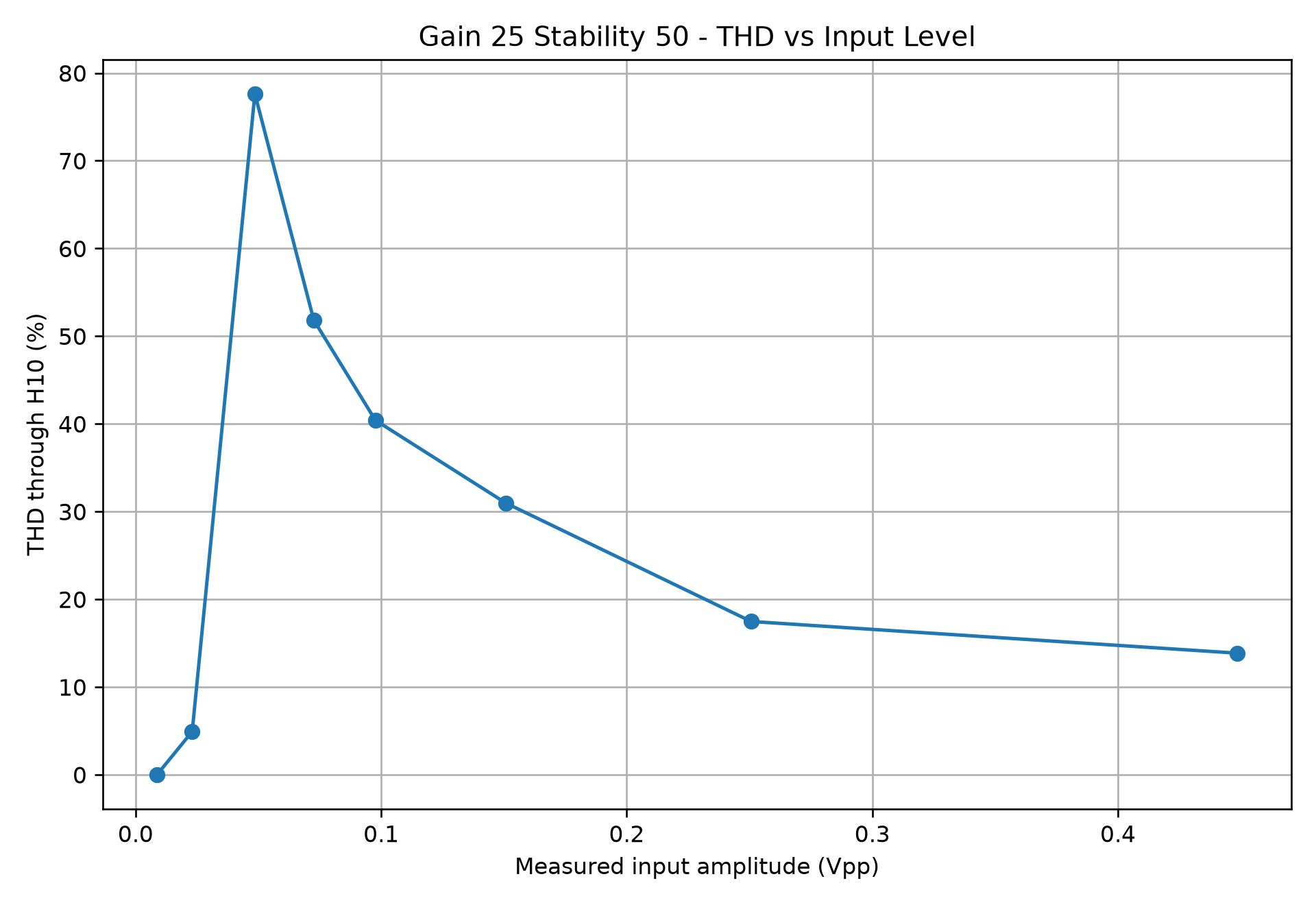
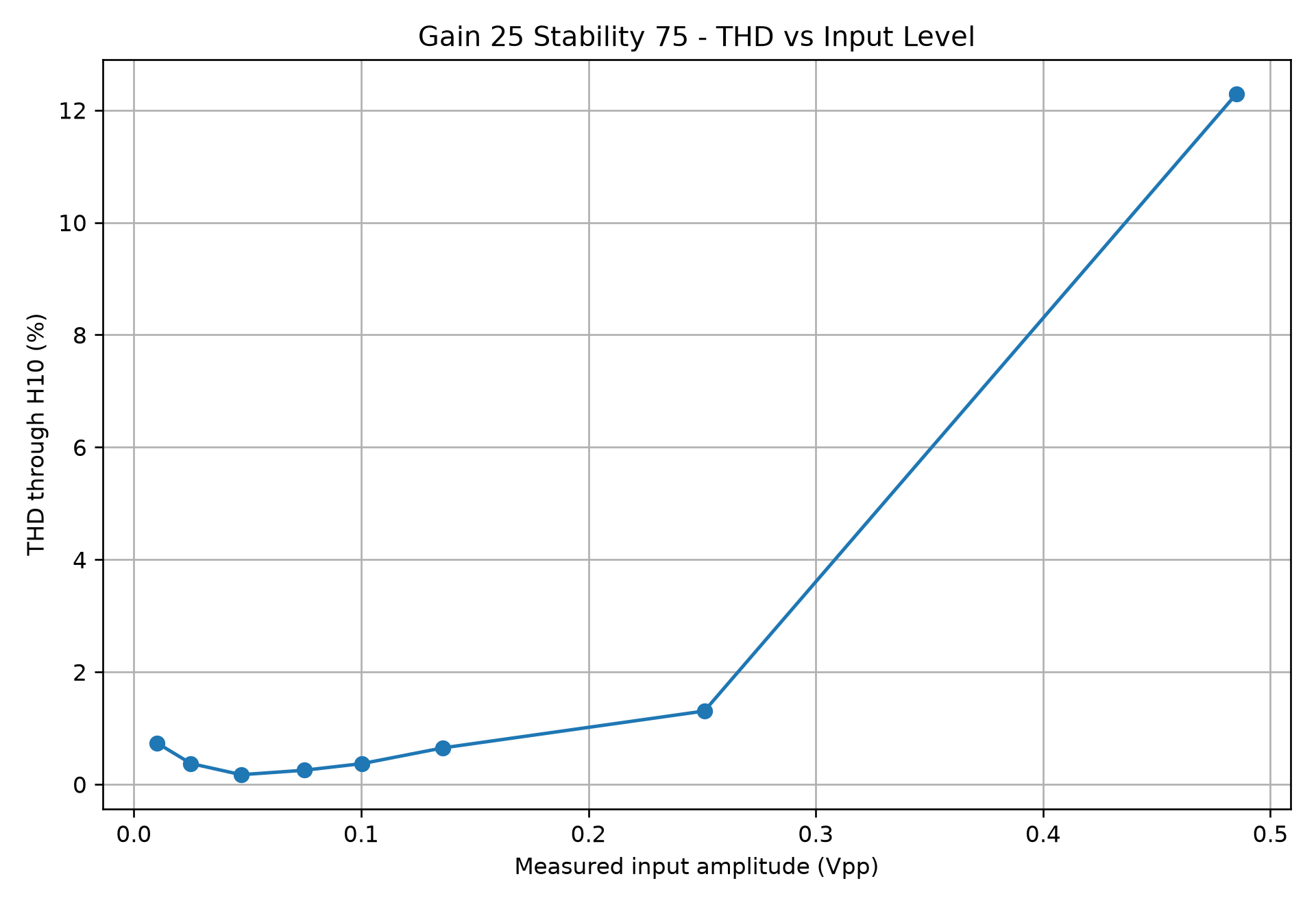
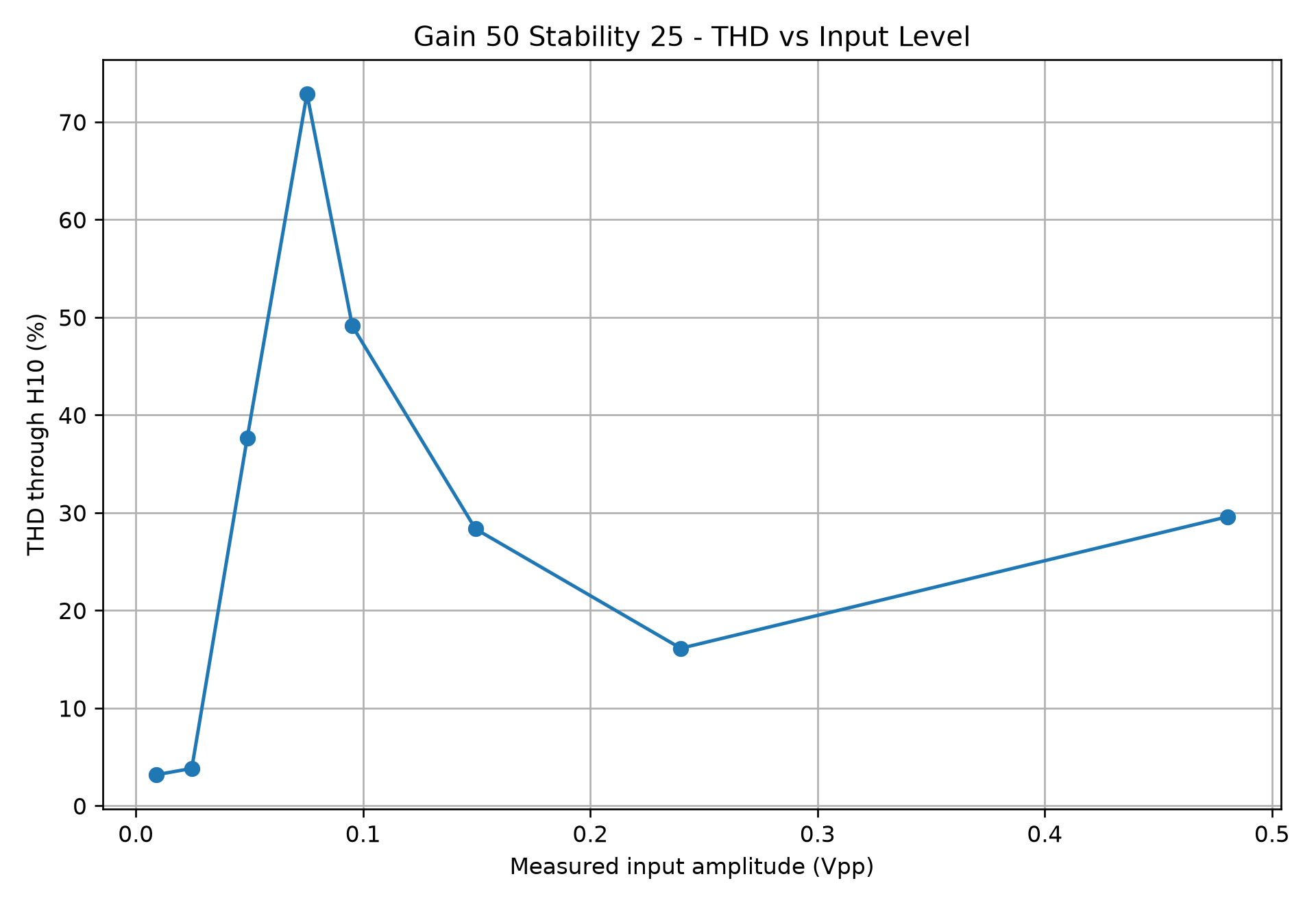
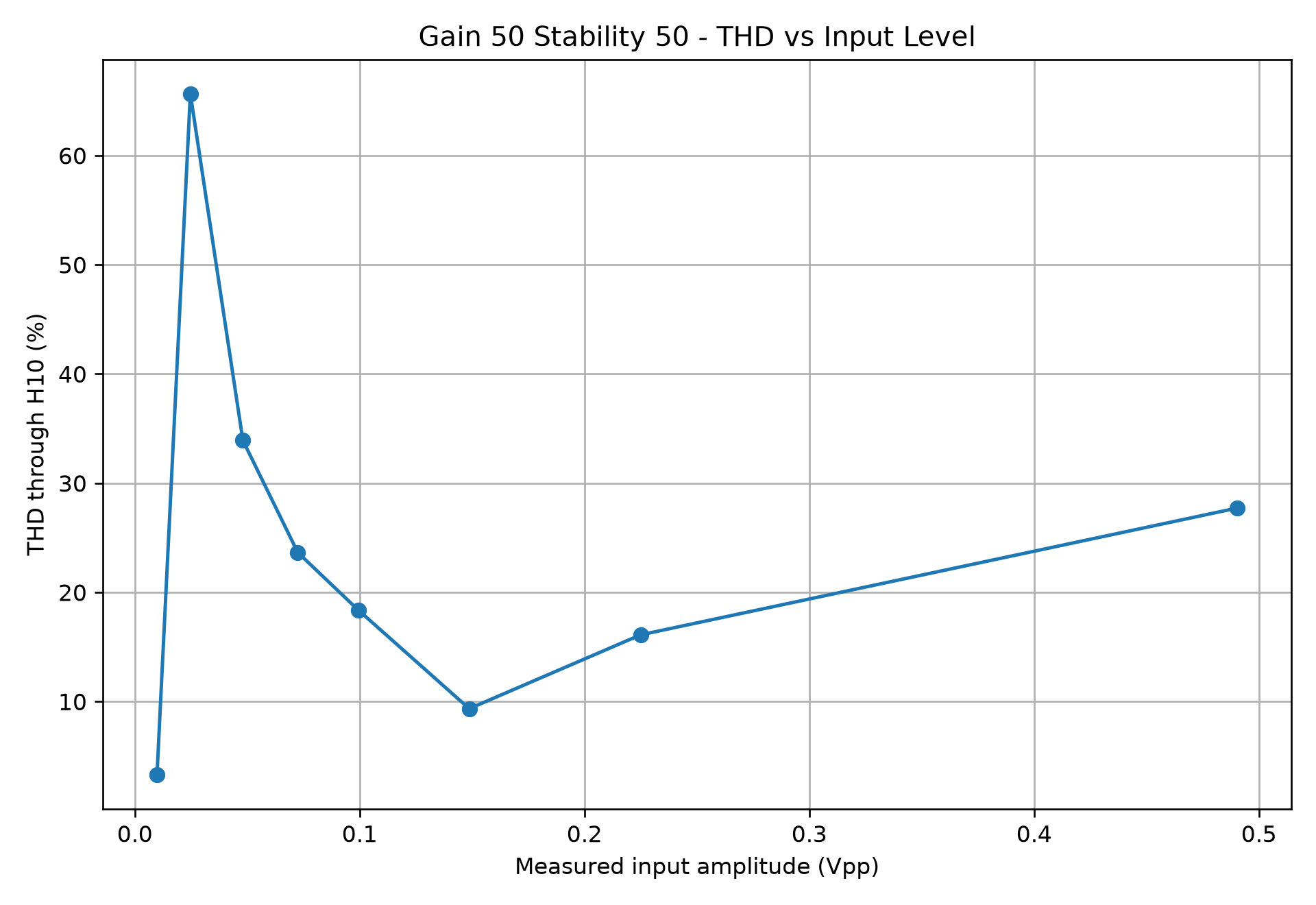
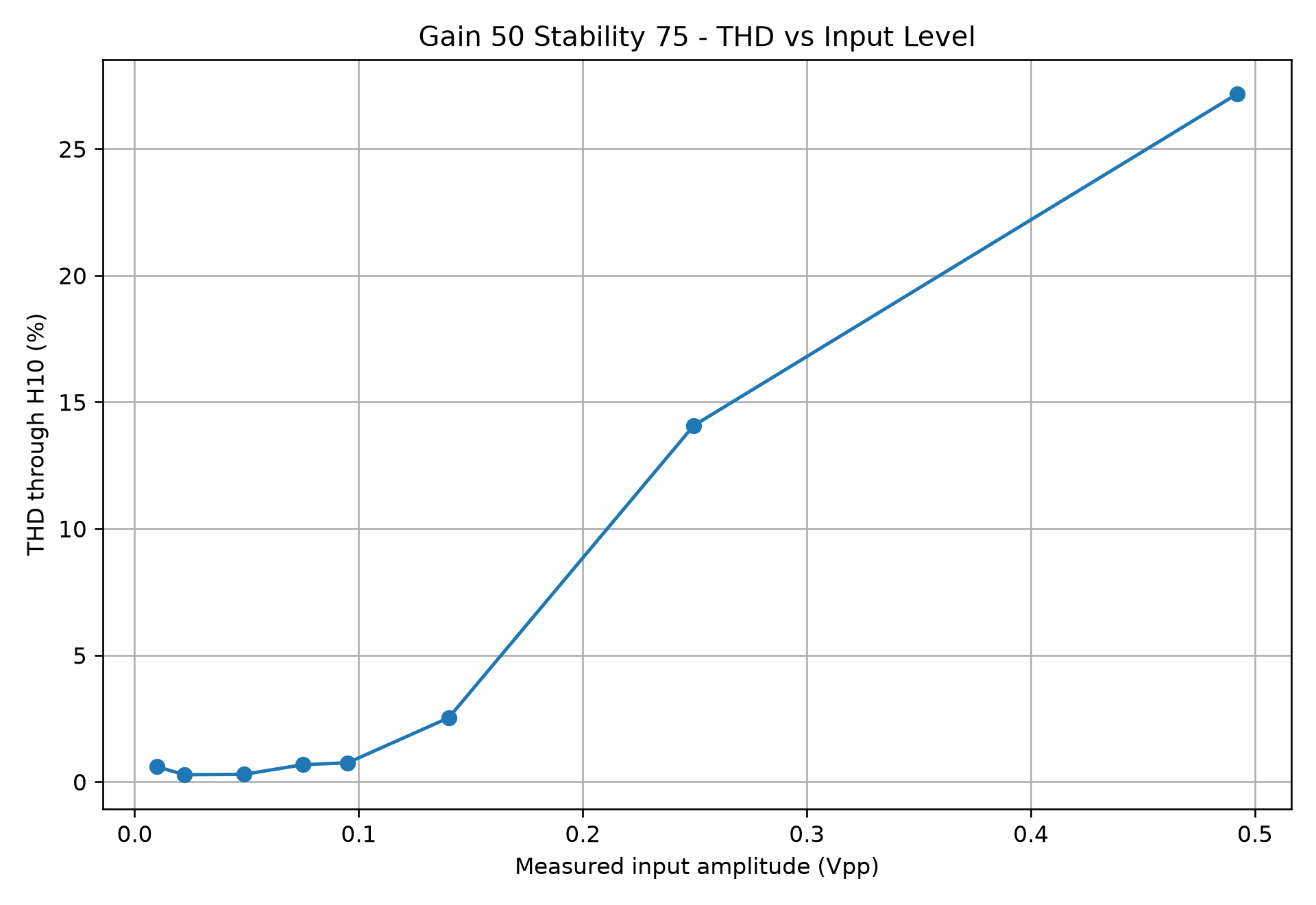
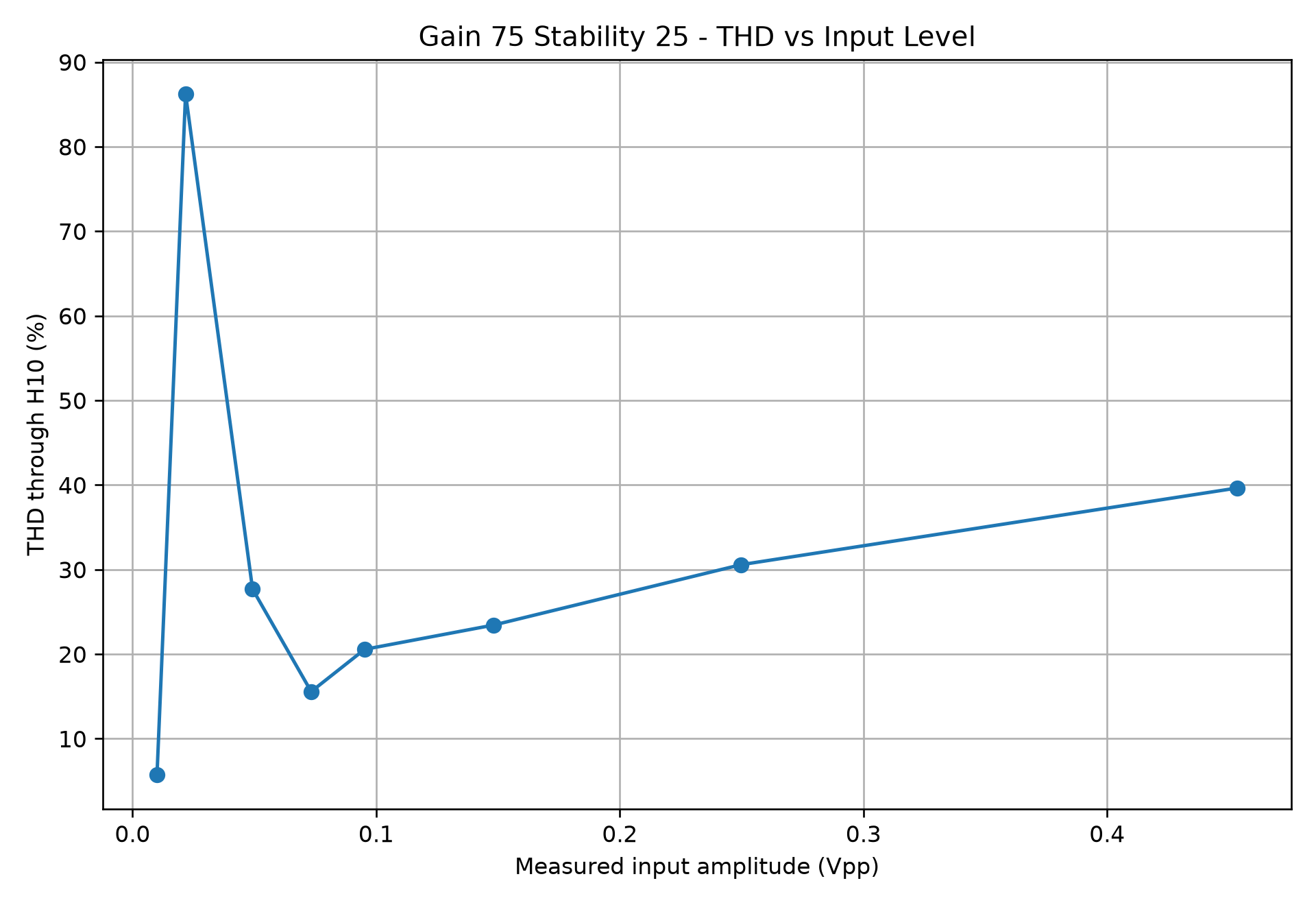
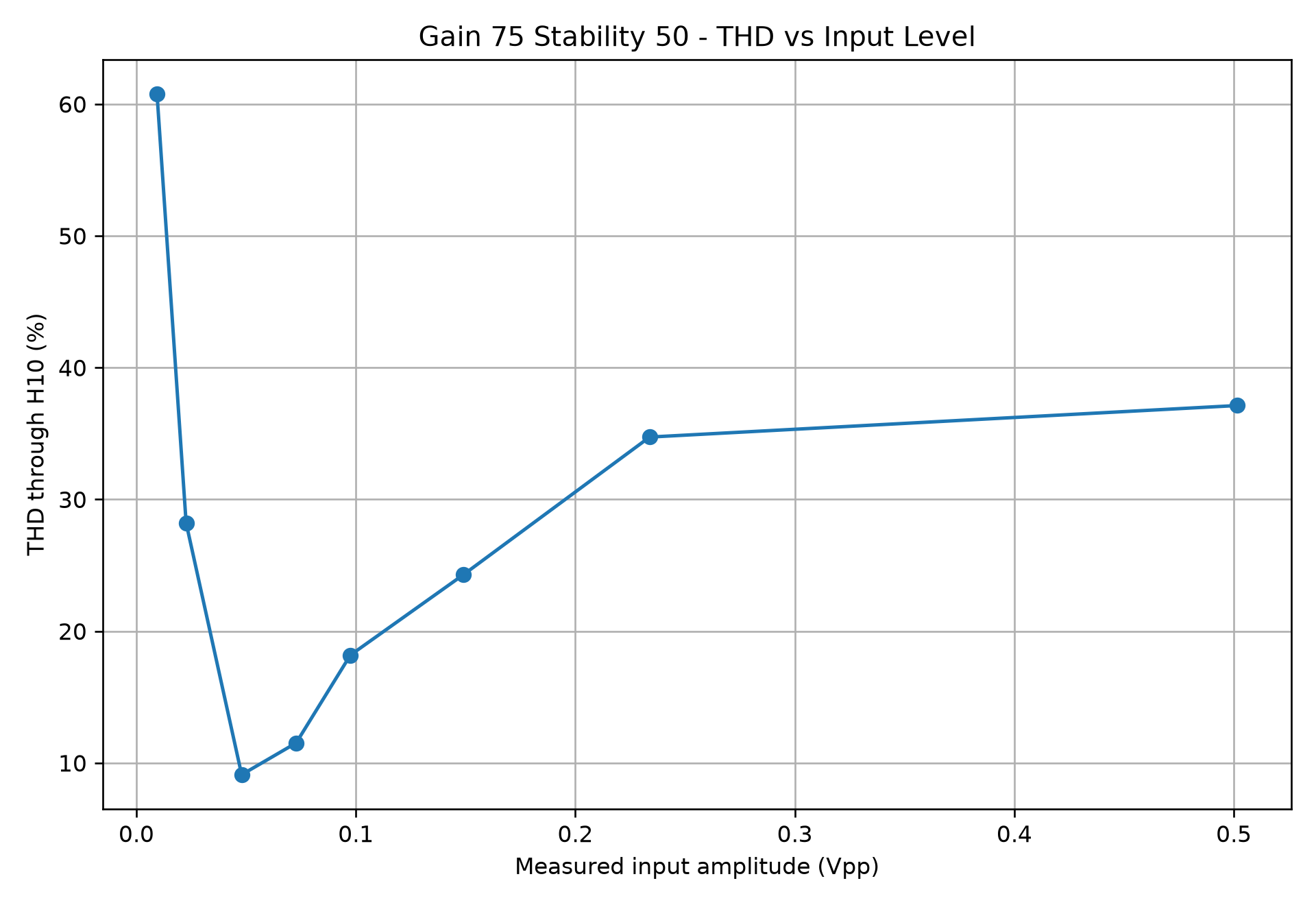
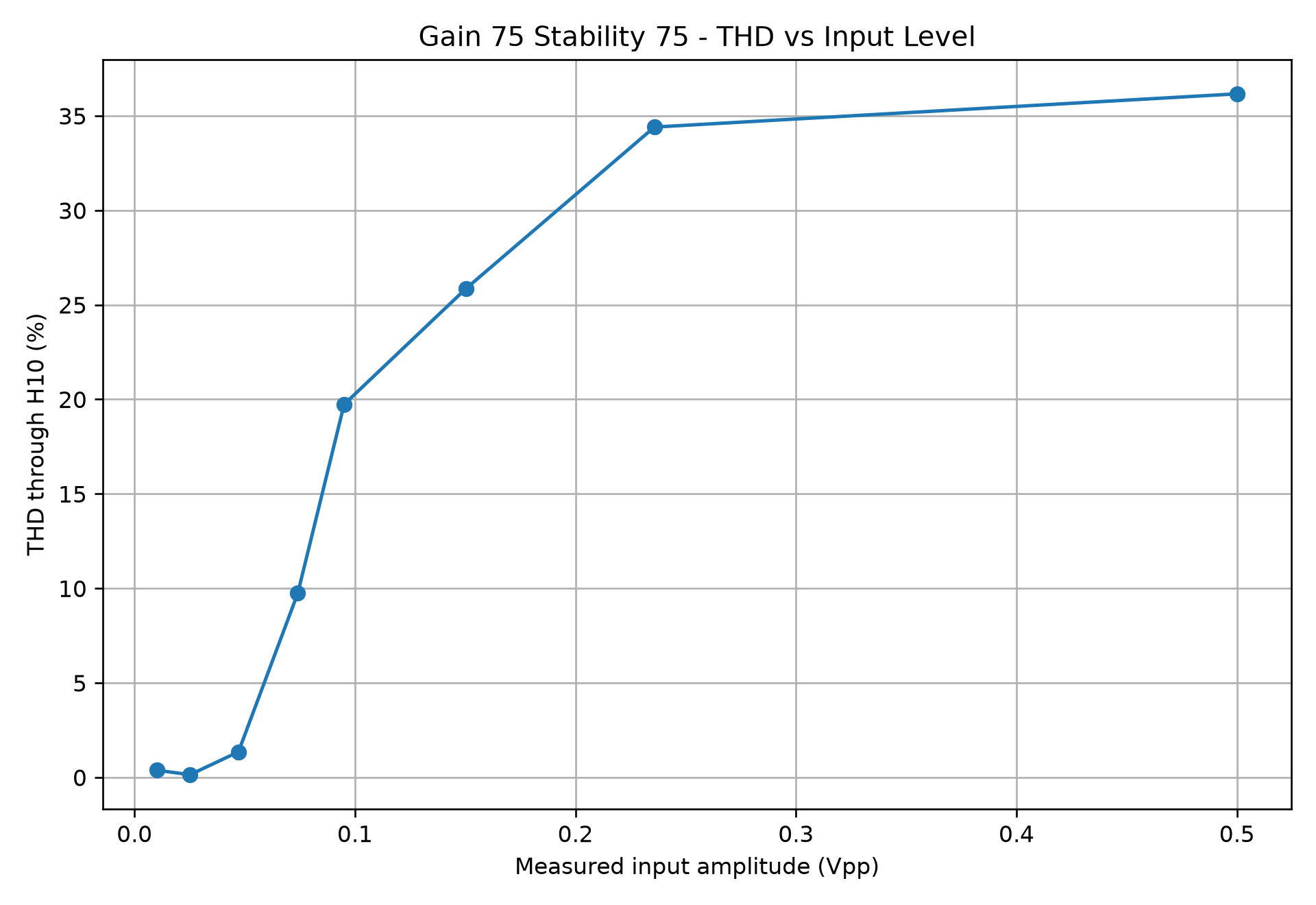
Figures 5-13: THD measurements at varying input levels
Across the Gain and Stability settings, three broad patterns appear in the measurements, an early THD peak followed by a decline, a broader peak followed by a decline, and a more conventional increase in THD with input level. Moving along the Stability or Gain axis changes the location, width, and magnitude of these features. There is no single transition point between the features, suggesting a strong interaction between the controls. This behavior reinforces the patterns seen in the earlier measurements.
Multi-frequency behavior
I wanted to determine if the behavior seen in the single-frequency THD measurements was specific to the test frequency or a broader characteristic of the circuit.
To investigate this, I measured intermodulation distortion (IMD) across the same Stability settings used in the THD vs input level measurements. Gain was held at 50% where much of the non-monotonic behavior was visible.
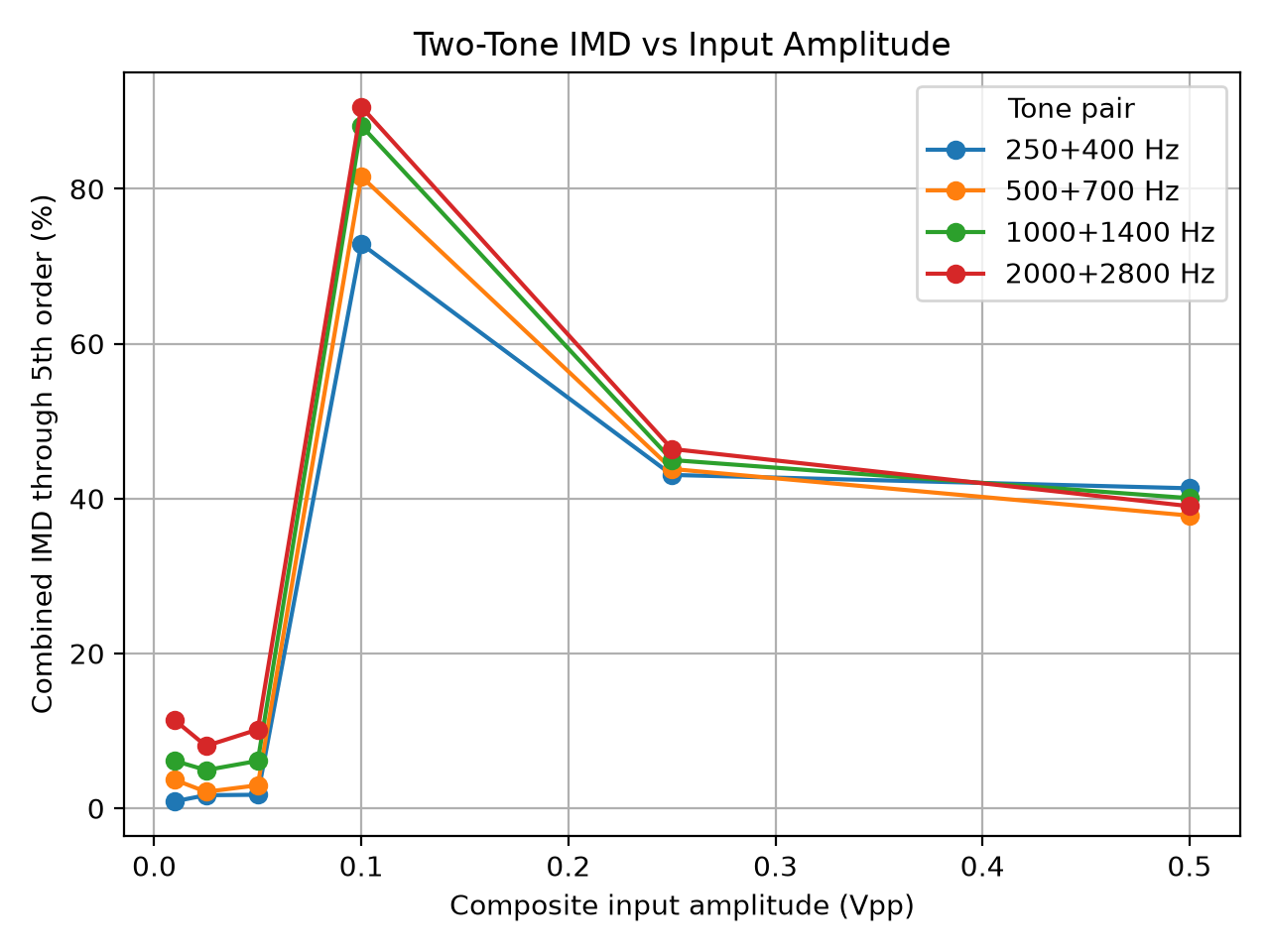
Figure 14: IMD vs input amplitude at 25% Stability
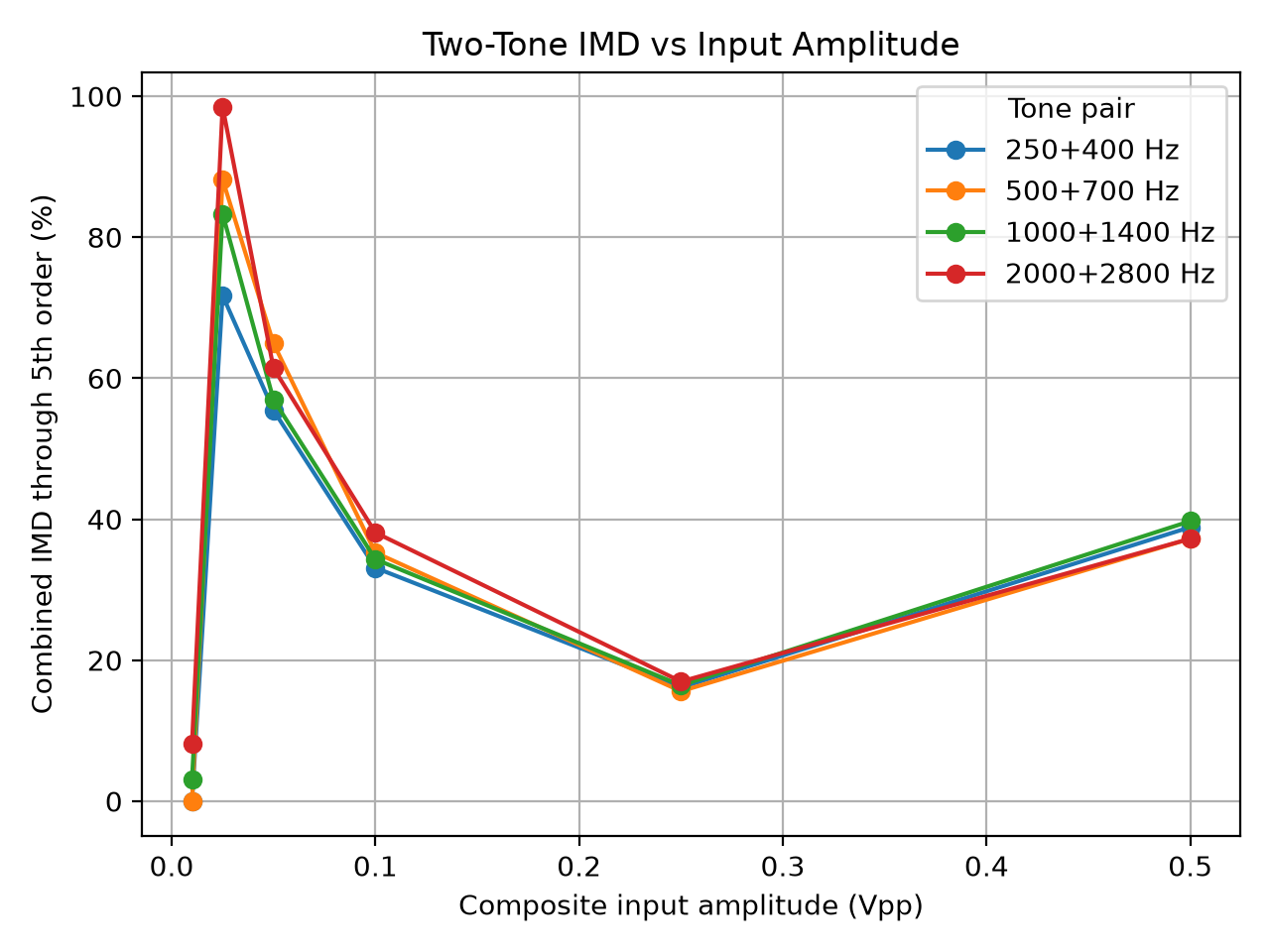
Figure 15: IMD vs input amplitude at 50% Stability
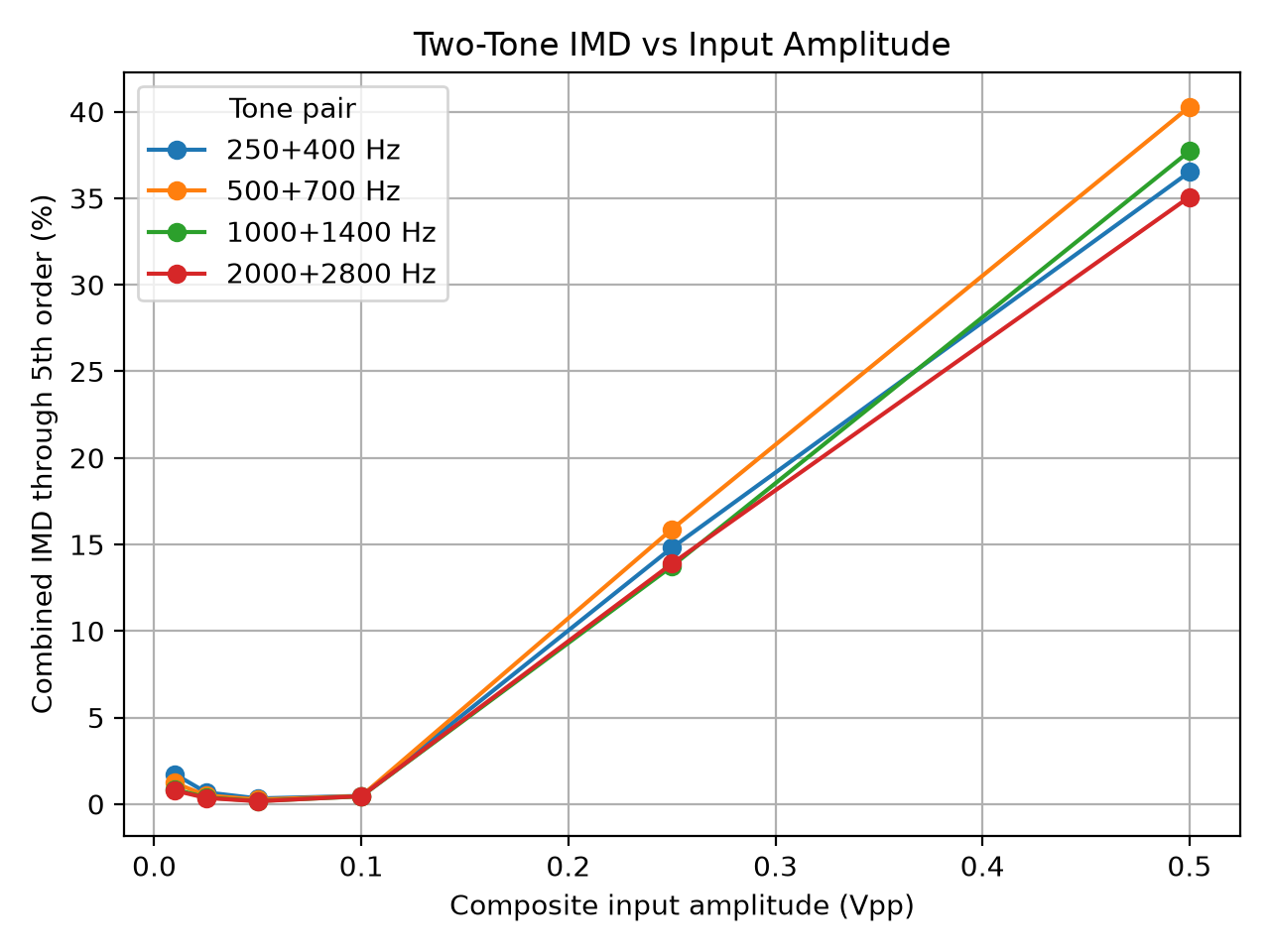
Figure 16: IMD vs input amplitude at 75% Stability
Across four different tone pairs, the IMD measurements show similar patterns to those seen in the THD measurements. This suggests the unusual behavior is not limited to a single frequency or an artifact of using single-tone input.
Tone and frequency response
Finally, I wanted to determine how the Tone knob interacts with Stability:
For these measurements, Gain was held at 50% while Tone was swept from 0-100% producing families of frequency-response curves:
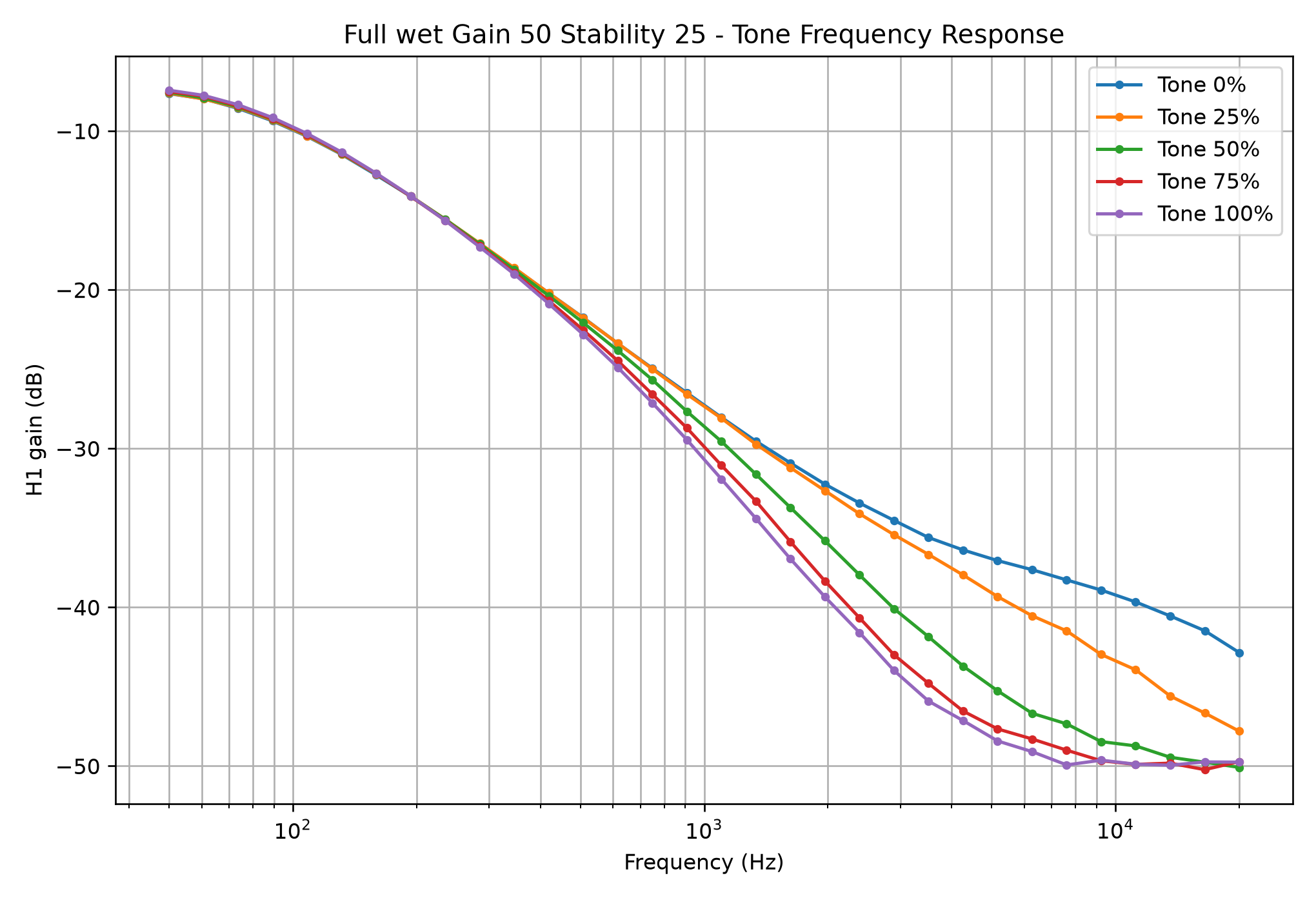
Figure 17: Frequency response at 25% Stability
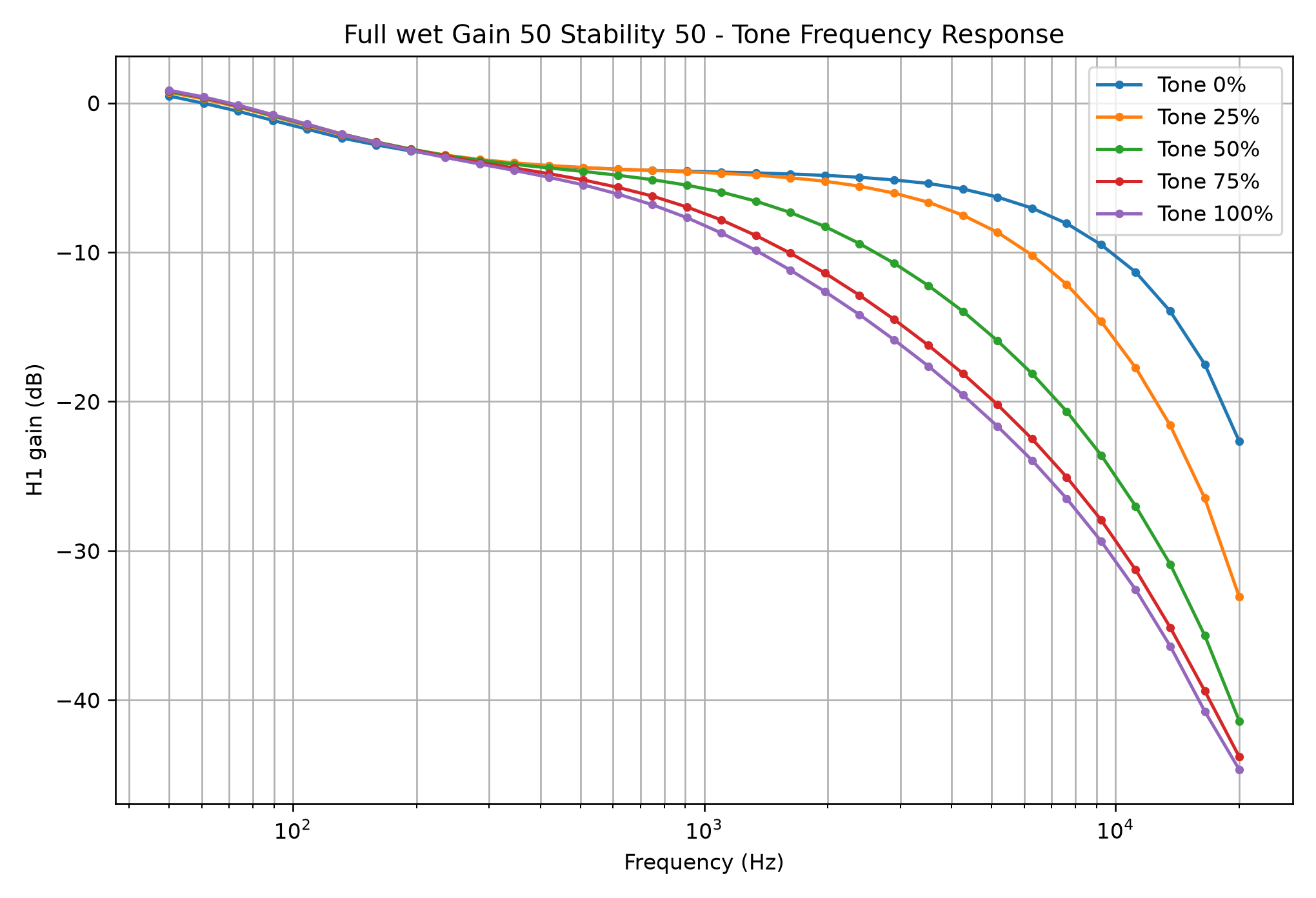
Figure 18: Frequency response at 50% Stability
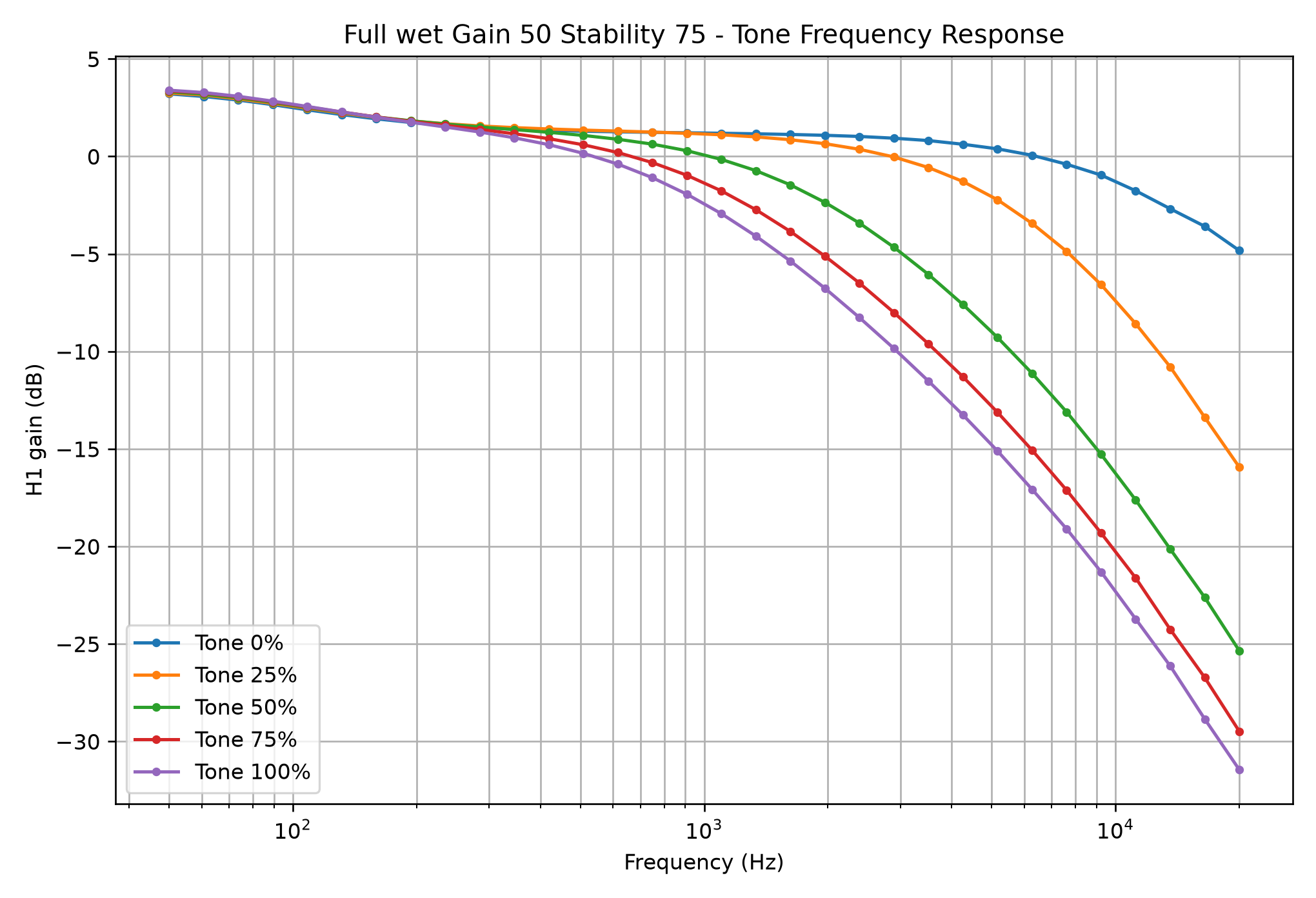
Figure 19: Frequency response at 75% Stability
The Stability level has a noticeable effect on the behavior of the Tone control.
At low Stability settings, the response is strongly shaped with significant attenuation of higher-frequency content beginning early in the spectrum. As Stability is increased, the response before the cutoff becomes progressively flatter and more high-frequency content is preserved.
Stability does not only affect the distortion mechanism, it also changes how strongly the Tone control shapes the signal.
Final thoughts
My original hypothesis was incomplete. Gain and Stability do not independently control distortion amount and character; instead, Gain, Stability, input level, and filtering interact as a coupled non-linear system. Depending on those conditions, THD can rise and fall and the harmonic balance can shift between even- and odd-dominant regimes. The IMD measurements demonstrate that this behavior extends to multi-frequency signals similar to those produced by a guitar, while the frequency response measurements show that Stability also affects the pedal’s filtering behavior.
That interaction was one of the original goals of Hysteris. The controls do not divide their roles as cleanly as I expected, but the measurements show that the circuit produces the unconventional and input-dependent distortion behavior I set out to create.
If you want to hear examples from the pedal or purchase your own, visit the Hysteris product page:
